


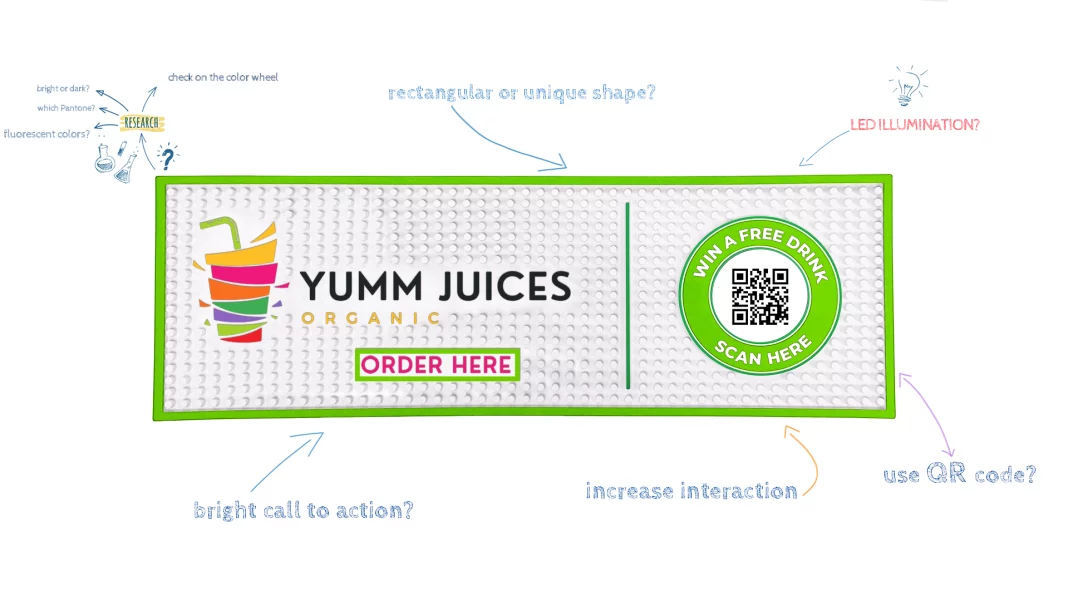

A custom bar mat has an unusual job. It needs to work as a practical surface for serving drinks while putting a brand directly in front of customers at the bar. Get the design right and those two jobs complement each other. Get it wrong and you may end up with an expensive rectangle carrying a logo nobody particularly notices.
At All In One Merchandise, we have worked on custom bar mats for beverage brands, hospitality businesses, events, and promotional campaigns for more than a decade. That has included conventional branded bar runners as well as custom-molded PVC designs, unusual shapes, printed graphics, illuminated elements, QR codes, NFC concepts, and other more specialized projects.
This guide is about the decisions that matter before manufacturing starts. There is no single design formula that works for every brand or venue. The objective is to make the mat noticeable, recognizable, useful, and appropriate for the environment in which it will actually be used.
Start with the job your bar mat needs to do
Before choosing colors, shapes, or clever technology, decide what success looks like. A bar mat created for permanent placement in hundreds of bars has a different job from one being used for a two-night product launch.
Your primary objective might be simple brand visibility. It could also be encouraging trial of a newly launched drink, promoting a particular serve, directing customers toward a campaign, supporting a brand activation, or simply making branded equipment available to bars stocking your product.
- Brand awareness: Make the brand and product immediately recognizable.
- Product trial: Give customers a reason to consider ordering the drink being promoted.
- Campaign engagement: Connect the bar mat to a QR code, competition, landing page, or social campaign.
- Brand activation: Create something sufficiently unusual to become part of the experience itself.
- Long-term bar placement: Prioritize practical dimensions, durability, clear branding, and ease of use.
You can combine objectives, but there should still be a hierarchy. If everything on the mat is treated as equally important, the design usually becomes harder to understand at a glance.
Choose the type of bar mat before finalizing the artwork
One of the easiest mistakes to make is designing a beautiful piece of artwork first and only later asking how it can be manufactured. Different bar mat constructions reproduce artwork differently.
Molded PVC bar mats
Custom-molded PVC is a strong option when shape, dimension, raised details, recessed areas, and bold blocks of color are important to the design. A mold is created around the approved design, which gives you considerably more freedom than simply printing a logo onto a standard rectangle.
This makes molded PVC particularly useful for recognizable bottle outlines, brand symbols, product silhouettes, unusual edges, raised lettering, and other three-dimensional design elements.
Printed bar mats
If the creative depends on photographs, gradients, detailed illustrations, campaign imagery, or a large number of colors, a printed construction may make more sense. It gives the artwork more freedom and can reproduce visual details that would be impractical to build entirely from molded PVC sections.
Neither approach is automatically better. A simple molded design can be far more effective than an elaborate printed one, and vice versa. Start with the communication objective, then choose the construction that reproduces the idea properly.
Use custom shape as part of the branding
The rectangle is useful, familiar, and often exactly the right choice. It is not, however, compulsory.
With a custom-molded PVC bar mat, the outside profile can become part of the creative. A bottle silhouette, bottle cap, shield, wave, badge, wordmark, geographic outline, or recognizable element from the packaging can help the mat look different before anyone has even read the logo.
There is a practical limit. A complicated outline with narrow projections or awkward areas may look interesting on a computer screen but work poorly when bartenders need somewhere stable to place glasses. Good custom design means finding the point where visual distinctiveness and usability meet.
One useful approach is to begin with something already distinctive about the product. Look at the bottle, can, label, iconography, typography, and packaging before inventing an unrelated shape purely for novelty.
Design for contrast, not just the brand guidelines
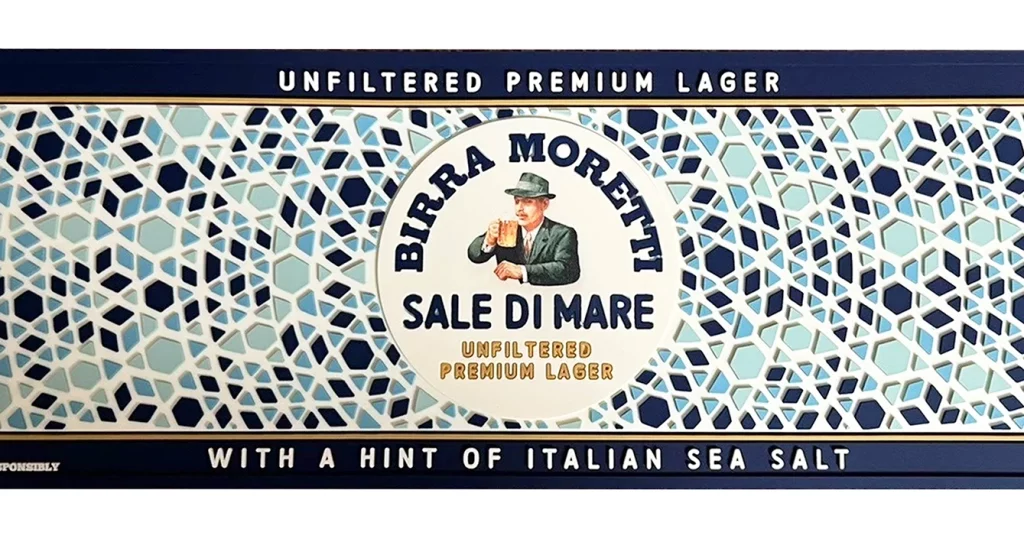
A bar is not a blank white artboard. The finished mat may sit on dark timber, stainless steel, stone, a colored counter, or a visually busy surface surrounded by bottles, taps, glasses, menus, screens, and other branded materials.
That environment should influence your color choices. A dark logo on a dark mat may be perfectly consistent with the brand guidelines and still disappear when placed on a bar.
You do not necessarily need fluorescent colors to solve the problem. Contrast can come from light against dark, complementary colors, negative space, a strong outline, a distinctive shape, or simply reducing the number of competing elements.
If you are developing a palette from scratch, tools such as the Adobe Color Wheel can help explore complementary and contrasting color combinations. More importantly, ask to see your bar mat proof at approximately the size at which customers will encounter it. A design that works while filling a desktop monitor can behave very differently on a bar.
Create a clear visual hierarchy
A bar mat does not need to communicate your entire marketing strategy. In most cases, someone should be able to look at it briefly and understand the important part.
Decide what gets noticed first. Usually that will be the brand, the product, or the campaign message. Everything else should support it.
- Keep the primary logo large enough to recognize quickly.
- Avoid filling every available area simply because space exists.
- Give important elements enough surrounding space to remain distinct.
- Keep small text to a minimum.
- Do not place essential information where glasses are likely to obscure all of it.
- If you use a call to action, make it visually subordinate to the brand unless the campaign specifically requires otherwise.
It sounds simple, but restrained artwork often requires more discipline than filling the mat with logos, slogans, social handles, website addresses, product shots, and legal copy all at once.
Use photography and faces when they add something
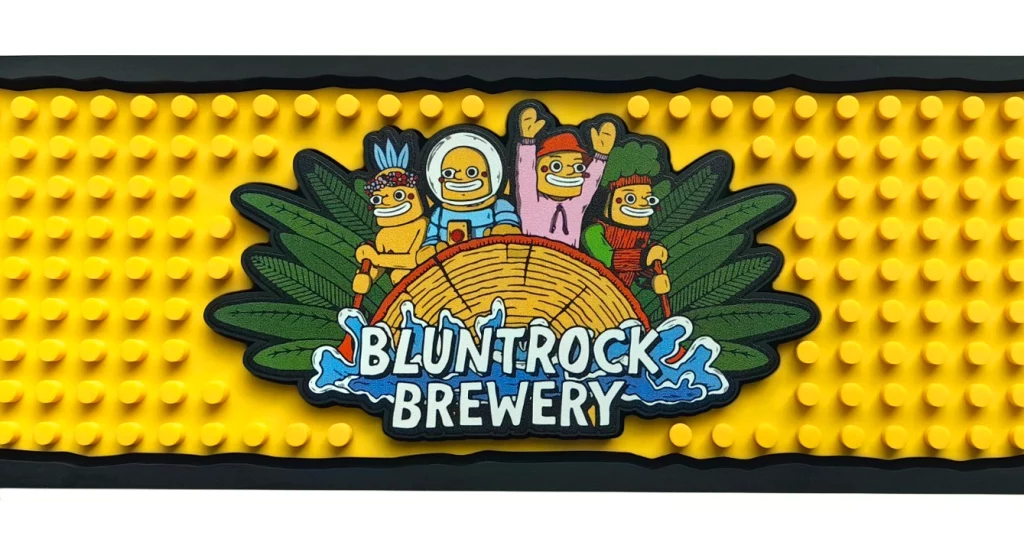
A molded PVC bar mat does not always have to consist entirely of flat-colored molded elements. Selected production methods can combine molded sections with printed graphics, opening the door to product imagery, illustrations, characters, and photographic elements.
That does not mean every bar mat needs a face on it. Imagery should have a purpose. A recognizable brand ambassador, campaign character, serving suggestion, product image, or expressive illustration can become a focal point when it supports the wider campaign.
Detailed printed elements also need to be evaluated at final size. What looks beautifully detailed in the artwork file may become visually insignificant once reduced to the dimensions of a bar runner.
Give your call to action something useful to do
Bar mats frequently stop at the logo. Sometimes that is exactly what the brief requires. But when a campaign has a specific next action, the mat can communicate that too.
A good call to action should be short and relevant to what someone can actually do while standing or sitting at the bar. Examples might include:
- Try [product name] here
- Ask for the signature serve
- Scan for cocktail recipes
- Scan to enter
- Find your nearest stockist
- Follow the brand
- Discover the range
Do not add a call to action merely because there is unused space. If you ask someone to scan, tap, follow, enter, or visit, there should be a useful experience waiting at the other end.
QR codes can connect the bar mat to a digital campaign
A QR code is one of the simplest ways to connect a physical bar mat with a digital destination. It can send someone to a campaign landing page, competition, product page, cocktail recipe, stockist finder, social profile, event experience, or another mobile-friendly destination.
The technology itself is easy. Execution is where campaigns can go wrong.
- Give the QR code enough clear space around it.
- Do not make it unnecessarily small.
- Maintain strong contrast between the code and its background.
- Avoid placing it across heavily textured or raised areas.
- Test the manufactured sample rather than relying only on the digital proof.
- Send visitors to a page designed for mobile devices.
- Use a trackable destination if campaign measurement matters.
- Tell people why they should scan it.
“Scan me” explains the mechanism. “Scan for cocktail recipes” explains the reward. The second is usually the more useful piece of communication.
NFC is useful when tapping is part of the experience
NFC can take the same physical-to-digital idea further. On suitable custom projects, an NFC tag can be incorporated so a compatible phone can trigger a digital action when brought close to the designated area of the mat.
The important question is not whether NFC sounds more advanced than a QR code. It is whether it improves the experience.
For a campaign where guests are encouraged to tap the mat to open an interactive experience, join a promotion, view content, or reach another digital destination, it can be an interesting feature. For a permanent bar mat that simply needs to show the brand clearly, it may add complexity without adding much value.
If NFC is being considered, discuss it before the bar mat is engineered. Tag position, construction, user instructions, and testing all need to be considered as part of the product rather than added as an afterthought.
LED bar mats make more sense for some campaigns than others
Illumination can make a logo, outline, or other design element much more conspicuous in a dark hospitality environment. It is also one of those features that makes far more sense in some situations than others.
We generally see the strongest case for illuminated bar mats in managed activations, launches, events, and other campaigns where somebody is responsible for setting up the display and making sure it remains operational.
A standard mat can be placed on a bar and largely left alone. Adding lighting introduces additional considerations such as power, charging, switches, storage, and staff instructions. The visual effect therefore needs to justify the extra operational work.
Do not let the marketing idea make the mat impractical
This is the less glamorous part of bar mat design, but it matters. The finished item still has to live on a working bar.
Drinks will be placed on it. Liquid will be spilled on it. Staff may move it, clean around it, stack it, store it, and put it back into service repeatedly. A complicated creative idea that interferes with those basic functions is unlikely to become the bartender’s favorite piece of equipment.
Before approving an unusual shape, detachable element, electronic feature, or other non-standard construction, ask a few practical questions:
- Is there enough usable area for glasses?
- Will the mat sit securely on the intended surface?
- Are important design elements still visible when drinks are placed on it?
- Can staff handle and store it conveniently?
- Does the design make sense for repeated use?
- If it contains interactive or powered elements, who will look after them?
The most memorable design is not necessarily the most complicated one.
Combine materials and promotional ideas carefully
There is room to go beyond a conventional one-piece bar mat. We have explored concepts involving additional branded elements, removable items, bottle caps, metal details, stickers, and small promotional pieces integrated into the wider design.
For example, a brand activation might incorporate removable branded tags that visitors can take away, with replacements added by staff during the event. The mat becomes both the display and the distribution point.
Ideas like this can work when there is a clear reason behind them. They also introduce more manufacturing, assembly, replenishment, and operational considerations, so they should be developed around a specific campaign rather than added simply to make a bar mat look unusual.
Write a proper brief before asking for a bar mat quote
You do not need finished artwork before requesting a quote, but a good brief makes it much easier to recommend the right construction and provide useful pricing.
Ideally, establish as much of the following as possible:
- Quantity: How many mats do you expect to need?
- Destination: Where will they ultimately be distributed or used?
- Dimensions: Do you need a conventional bar runner or something more compact?
- Construction: Are you considering molded PVC, a printed mat, or are you open to recommendations?
- Shape: Standard rectangular or a custom outline?
- Artwork: Logo only, campaign artwork, photography, product imagery, or another concept?
- Colors: Are there specific brand colors that need to be reproduced?
- Features: Are you considering QR, NFC, illumination, or another special element?
- Use: Permanent placement, sales promotion, event, product launch, sampling campaign, or another activation?
- Deadline: When do the finished mats need to be in hand?
If you do not know all the answers, that is fine. A good supplier should help resolve the technical questions rather than expect you to arrive knowing how bar mats are manufactured.
Custom bar mat design checklist
If you are already working on artwork, this is the checklist I would run through before approving it:
- Can you immediately identify the brand?
- Is there a clear visual hierarchy?
- Will the important elements contrast with the bar and surrounding environment?
- Does the shape add something useful or is it unusual purely for the sake of being unusual?
- Is there enough practical space for drinks?
- If there is a call to action, is it short and worthwhile?
- If QR, NFC, or illumination is included, does it genuinely improve the campaign?
- Has the design been reviewed at approximately its finished physical size?
- Does the chosen manufacturing method suit the artwork?
- Has a physical production sample been considered where the complexity or order size justifies one?
Frequently asked questions about custom bar mats
Can bar mats be made in custom shapes?
Yes. Custom-molded PVC bar mats can be manufactured in non-standard outlines because the mold is created around the approved design. Bottle shapes, brand symbols, badges, waves, and other practical outlines can all be considered. The design still needs sufficient usable surface area for its intended purpose.
Can you print photographs on a PVC bar mat?
Printed graphics can be combined with selected PVC bar mat constructions, allowing artwork to include more detail than molded color sections alone. The appropriate method depends on the design, so photographic or highly detailed artwork should be reviewed before production is specified.
Can a QR code be printed on a custom bar mat?
Yes. QR codes can be incorporated into suitable bar mat artwork. Keep the code clear, sufficiently large, high contrast, and away from areas where heavy texture or dimensional details could interfere with scanning. Always test the finished product before a campaign is deployed.
Can NFC be added to a bar mat?
NFC can be incorporated into selected custom bar mat projects. Because the tag becomes part of the product construction, it should be discussed at the beginning of the project rather than after the bar mat has already been designed.
Are illuminated bar mats available?
Illuminated and LED bar mat concepts are possible for selected projects. They are particularly worth considering for events and managed brand activations where the additional setup, power, and charging requirements can be properly handled.
What is the best design for a branded bar mat?
There is no universal best design. A strong bar mat usually combines recognizable branding, sufficient contrast, a clear hierarchy, practical dimensions, and a manufacturing method suited to the artwork. Special shapes, QR codes, NFC, lighting, and other features should be added when they support the campaign rather than treated as requirements.
The best bar mat idea is the one that works on an actual bar
A custom bar mat can be much more than a logo molded into a rectangular strip of PVC. Shape, contrast, imagery, printing, calls to action, QR codes, NFC, lighting, and additional promotional elements give marketers plenty to work with.
But more features do not automatically produce a better bar mat. Start with the audience and objective, choose the right construction, make the branding easy to recognize, and then add creative elements where they earn their place.
If you are developing a project for the US market, you can browse our custom bar mats or contact our team with your artwork, quantities, deadline, or even just an initial idea. Our designers can help prepare or repair logo files and convert artwork into a suitable format for production free of charge.

